The Minaret of the Eski Mosque—a forgotten witness to Byzantium on Istanbul’s Fourth Hill
The Minaret of the Eski Mosque (Turkish: Eski İmaret Camii, “Old Imaret Mosque”) is the only 11th-century church in Istanbul that has survived almost entirely intact. Behind its modest facade, nestled among the residential buildings of the Zeyrek district, lies the former monastery of Christ Pantophtos—"the All-Seeing." In the early 13th century, this was the headquarters of the last Byzantine emperor before the fall of Constantinople; later, it housed a soup kitchen (imaret) for the Fatih Mosque under construction; and from here, Benedictine monks administered the church during the Latin occupation. The minaret of the Eski Mosque remains the least studied monument of the city’s Middle Byzantine architecture—and this is precisely what makes it so appealing to those who are tired of the tourist crowds in Sultanahmet.
History and Origin of the Eski Mosque Minaret
The history of the building dates back to the second half of the 11th century, during the Komnenos dynasty. Shortly before 1087, Anna Dalassina, mother of Emperor Alexios I Komnenos, founded a convent dedicated to Christ Pantoptos—"the All-Seeing"—on the summit of the fourth of Constantinople’s seven hills. She retired here at the end of her life, following a long-standing imperial tradition. The monastery complex included a church dedicated to the same Christ the All-Seeing, and it is this very church that has survived to the present day.
The most dramatic episode in the church’s history occurred on April 12, 1204. That night, Emperor Alexius V Doukas Mourzoufl set up his headquarters near the monastery: from the hilltop, he watched as the Venetian fleet under the command of Doge Enrico Dandolo maneuvered between the Evergetis Monastery and the Church of Blachernae. After a crushing assault by the Crusaders, the emperor fled, abandoning his purple tent—and it was in that tent that Baldwin of Flanders spent his night of victory. An echo of this event has been preserved in the Fourth Novgorod Chronicle: the Russian chronicler recounts how Murzufl climbed the dome of Pantopta to survey the enemy fleet in the Golden Horn.
After the complex was plundered by the Crusaders, it was handed over to Benedictine monks from the Roman monastery of San Giorgio Maggiore, and during the Latin occupation of 1204–1261, the church became a Catholic church. After the Ottomans captured Constantinople in 1453, Sultan Mehmed II converted the church into a mosque, and the monastery buildings into a zawiya (dervish lodge), a madrasa, and an imaret that served the nearby Fatih Mosque, which was under construction. It is from this soup kitchen that the current Turkish name derives: “The Old Imaret Mosque.”
The complex burned down several times, and the last remaining monastery buildings disappeared about a century ago. Until 1970, the building was used as a school for the study of the Quran, which effectively closed it off to architectural research. This is precisely why the Minaret of the Old Mosque is still referred to as “the least studied Byzantine church in Istanbul.”
The identification of the building with the Pantopta Monastery, accepted on faith for nearly two centuries, dates back to the Patriarch of Constantinople, Constantius I, who proposed this theory between 1830 and 1834. Most researchers of the 19th and 20th centuries repeated his conjecture without verification. It was not until the mid-20th century that Cyril Mango, the foremost expert on Byzantine topography, proposed an alternative location for Pantopta—on the site of the present-day Yavuz Sultan Selim Mosque. German scholars Asutay-Effenberger and Effenberger supported Mango, reinforcing the hypothesis that Eski Imaret is an entirely different church. In any case, the building remains a genuine key to understanding the Komnenos era, even if its name is still a matter of debate.
Architecture and What to See
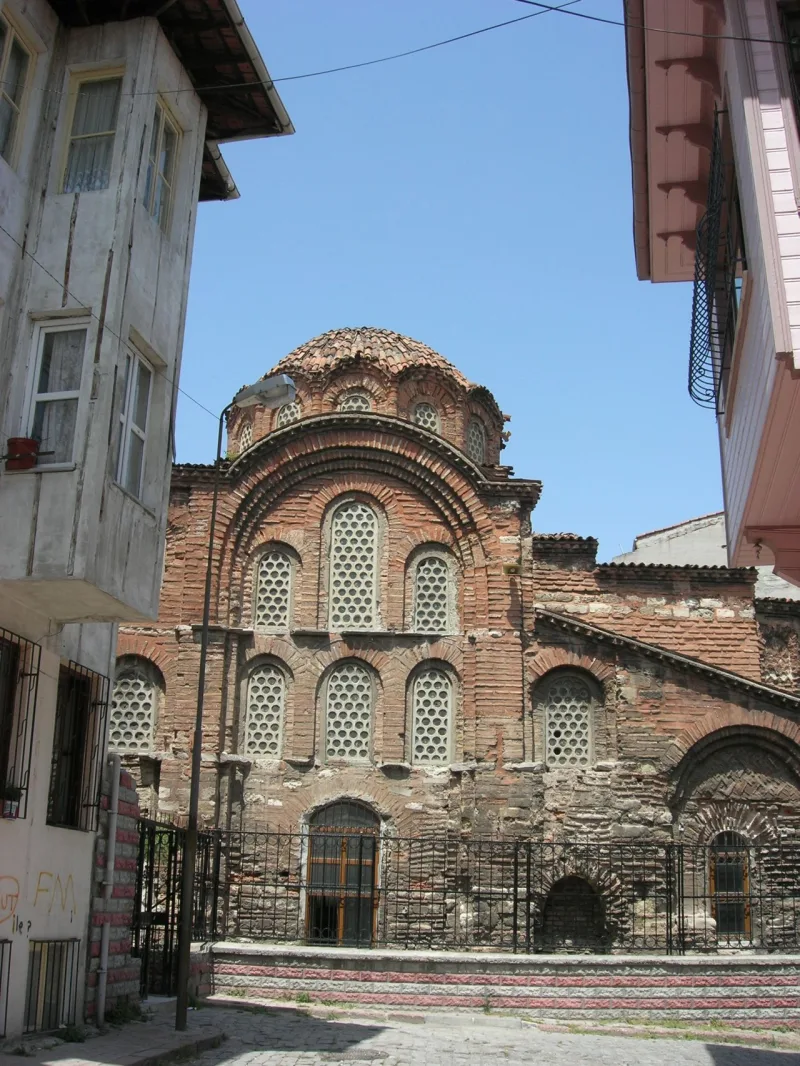
The building is situated on a steep slope facing the Golden Horn and rests on a platform—the roof of an ancient underground cistern, whose floor serves as the church’s floor. The structure is surrounded on all sides by later-built houses, which makes it very difficult to view from the outside. And yet, it is precisely this seclusion that gives the church a special atmosphere: it seems to be hiding within the fabric of the city, waiting for a careful glance.
Recessed brickwork—the oldest in Istanbul
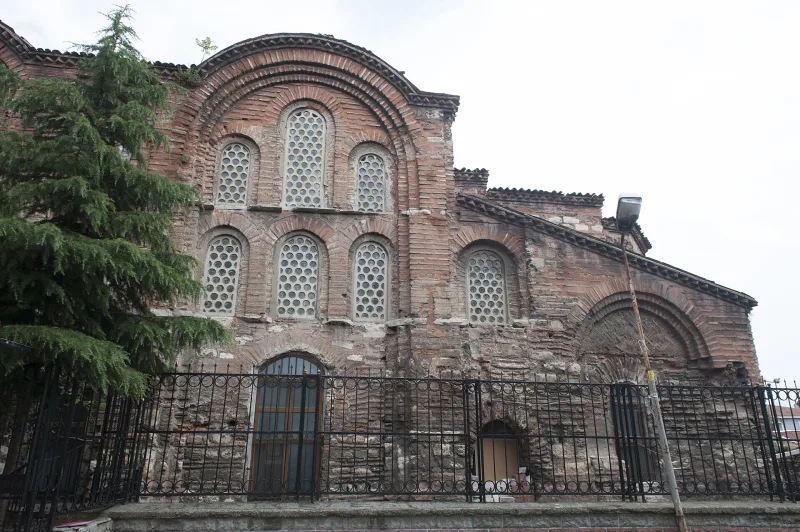
The walls are built of brick and stone using the so-called “recessed brick” technique. Alternating rows of bricks are set back into the wall and filled with a thick layer of mortar—about three times thicker than the brick layers themselves. This is the oldest surviving example of this technique in Constantinople, which became a hallmark of Middle Byzantine architecture and later spread widely throughout Rus’. Architectural historians from all over the world come here specifically to see this detail.
Unique Brick Roof
Another rarity: the roof is covered not with lead sheets, as in most churches and mosques in Istanbul, but with brick tiles. During the Ottoman reconstruction, the undulating silhouette of the roof was concealed beneath a flat roof, and the dome was given a helmet-like shape. The 1970 restoration restored the dome’s original scalloped outline, characteristic of Macedonian-period churches, and returned the gallery’s tiled roof to the gentle curves of the vaults.
"Inscribed Cross" Plan and U-Shaped Gallery
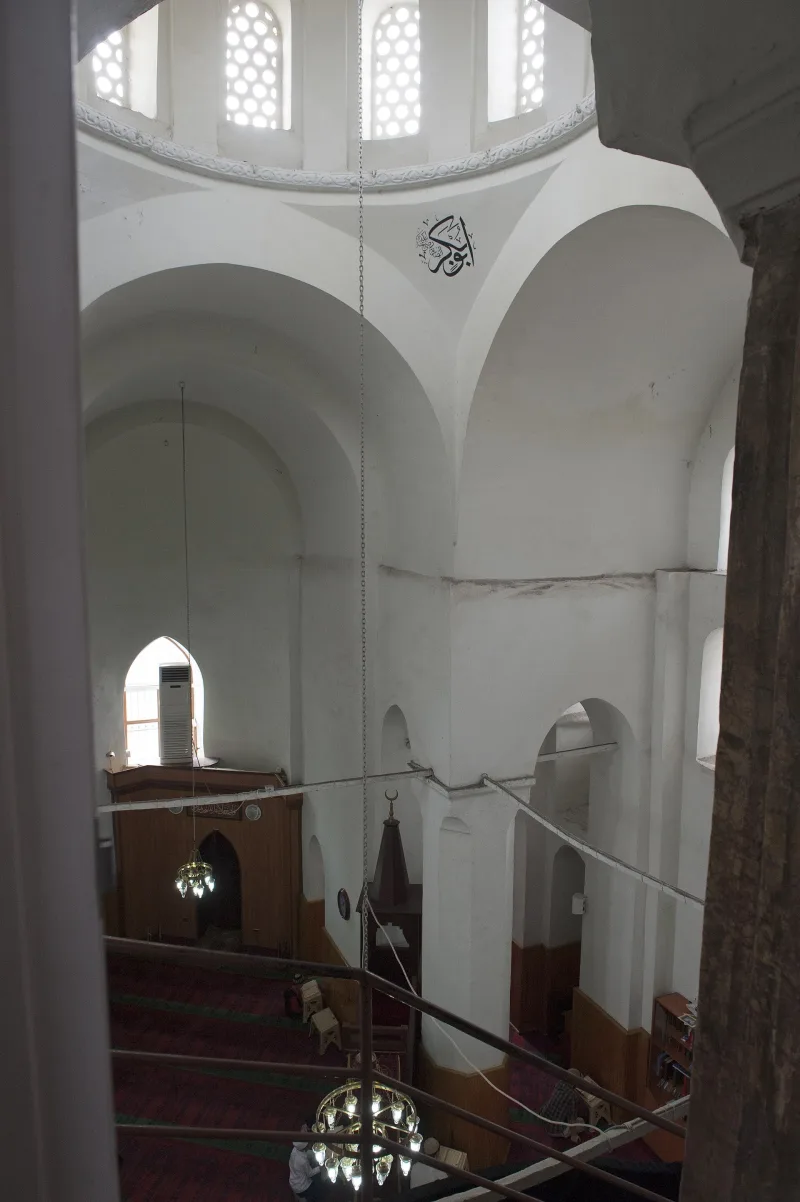
The church’s plan belongs to the “inscribed cross” (quincunx) type: the central dome rests on four arms, with the altar to the east and the esonarthex and exonarthex to the west. The outer narthex, added later during the Palaiologos era, is divided into three sections: the side sections are covered by cross vaults, and the central section by a small dome. On the western side runs an exceptionally rare feature—a U-shaped gallery encircling the narthex and the two western arms. Its windows open onto both the naos and the arm of the cross. Most likely, this gallery was built for the personal use of the Empress Dowager Anna Dalassina herself.
Trilobate side chapels and traces of the Ottoman era
The four columns that once supported the space beneath the dome were replaced by massive pylons, and the side aisles lead to small trilobate side chapels—the prothesis and the diaconicon—which, like the main altar, feature semicircular apses. The Ottomans plastered the apses and added a minaret, which was later dismantled. During the 1970 restoration, architect Fikret Çuhadaroglu removed the broken altar minaret and restored the original forms. Traces of the second, “unauthorized” renovation of the 1990s are still visible in the masonry details.
Facade Decor
The exterior walls are decorated in places with decorative motifs—sunbeams, meanders, “wickerwork” in the form of a basket, and cloisonné masonry. The latter technique is characteristic of Greek architecture of this period, but is found nowhere else in Constantinople. Of the interior decoration from the Komnenos era, only the marble moldings, cornices, and door jambs have survived—no frescoes, no mosaics, and no iconostasis.
Interesting Facts and Legends
- According to legend, it was from the dome of the Pantheoptos that Emperor Alexios V watched the Crusaders’ advance in April 1204. The greatest Byzantinist of the 20th century, Cyril Mango, personally climbed the dome of the Eski Imaret to verify the legend—and discovered that the Golden Horn is not visible from there: it is obscured by a neighboring hill. It was this experiment that cast doubt on the identification of the building with the Pantopopt.
- Baldwin of Flanders, the first Latin Emperor of Constantinople, spent the night of victory right in the purple tent of the fleeing Murzulf, pitched against the monastery walls.
- The Turkish name “Eski Imaret”—“Old Kitchen”—reminds us that immediately after 1453, the former monastery became a soup kitchen for the workers building the gigantic Fatih Mosque. The imaret also fed the poor of the neighborhood.
- Since 1970, the building has been closed to the general public: it has been used alternately as a Koranic school and as a site of endless restoration. Work, which began in 2015 with plans to open in 2019, was unexpectedly put on hold and, as of 2024, is still ongoing.
- German researchers Asutai-Effenberger and Effenberger have suggested that the building may not be Pantopom at all, but rather the Church of Saint Constantine, founded by Empress Theophano in the early 10th century—so much so does it resemble the contemporary Lipsa Monastery.
How to get there
The mosque is located in the Fatih district, in the Zeyrek neighborhood, less than a kilometer northwest of the more famous Zeyrek Mosque (the former Pantokrator Monastery). Landmarks for navigation are Küçükpazar Caddesi and Küçük Mektep Sokak: it is from this tiny street that the only decent view of the mosque opens up.
The most convenient way from Sultanahmet is to take the T1 tram (Kabataş–Bağcılar line) to the “Laleli-Üniversite” or “Aksaray” stop, then walk 15–20 minutes uphill. From Eminönü, it’s a half-hour walk through the Unkapanı district and the market streets. From the Fatih Mosque, it’s a 10-minute walk. From IST Airport, the most convenient way is to take the M11 metro to “Gayrettepe,” then the M2 to “Vezneciler,” and from there walk about 15 minutes uphill. From SAW Airport—take the Havabus to Kadıköy, then the ferry to Eminönü, and from there walk or take a taxi (about 10 minutes).
The Zeyrek district is one of the poorest areas within the old city walls; the streets are narrow and steep, with cobblestone pavements. Be prepared for a steep climb and uneven surfaces. Neither the tram nor the metro runs directly here, so you’ll have to walk the last 800–1,200 meters of the route in any case. If you’re traveling with children or elderly relatives, it’s best to take a taxi (on the Istanbul apps BiTaksi or iTaksi, a ride from Eminönü will cost 80–120 Turkish lira). Instead of the mosque’s name, show the driver the address “Küçükpazar, Küçük Mektep Sokak”—local taxi drivers know this specific street.
Tips for travelers
The main thing to know in advance: as of spring 2026, the building is still under restoration, and access inside is generally closed. However, the trip here is still worthwhile—viewing the facade, the neighboring streets of Zeyrek, and the panorama of the Golden Horn from the adjacent terraces are well worth the time spent. Check the access status before your visit on the city forums at istanbul.com and in the Turkish-language section of kultur.gov.tr.
The best time to visit is early morning or late afternoon in spring (April–May) and fall (September–October). In summer, the marble pavement gets hot, and the steep streets in the shadow of the facades turn into stuffy corridors. In winter, rain and slippery stones are possible: shoes with non-slip soles are a must. Allow 45–60 minutes to explore the building itself and the surrounding neighborhoods; if you plan to combine your visit with the Zeyrek Mosque and the Fatih Mosque, allow 3–4 hours.
Russian-speaking travelers will find it interesting to recall that it was precisely the hidden-row masonry technique, first used here in Constantinople, that later came to Rus’ and was reflected in the pre-Mongol churches of Kyiv and Novgorod. For fans of Mandelstam and Gumilev, Zeyrek offers a rare chance to experience “another Constantinople”—the one that never made it onto postcards. Bring water, comfortable shoes, and a camera with a fast lens: there’s little sunlight in the narrow alleys.
Nearby sites for a combined itinerary: Zeyrek Camii (UNESCO site, 800 meters), Fatih Mosque (1 km), Valens Aqueduct (1.5 km), and the ancient Bonos Cistern (excavations are underway 200 meters away). If you head down to the Golden Horn, in 15 minutes you’ll find yourself at the Halic and can take a ferry to Balat—another atmospheric Byzantine-Ottoman neighborhood. The minaret of the Eski Mosque isn’t a postcard-perfect sight, but a quiet encounter with authentic Byzantium, and it is precisely in this quietness that its main charm lies.